toolbox
A place that makes science tangible
Exhibited at the Bavarian Arts and Crafts Association, Munich (Bayerischer Kunstgewerbeverein e.V.)
PROJECT
ReMake Science · A ship for the encounter between science and people
Collaboration with Elisa Meincken
SUPERVISION
Professor Rita Rentzsch · Research Associate Luise Schuhmann
Period
Summer semester 2025
·
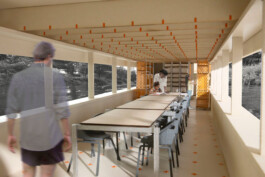
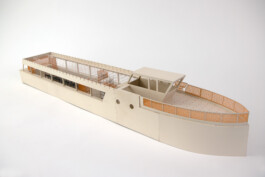
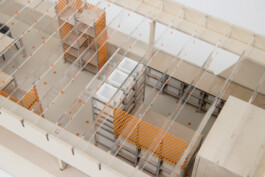
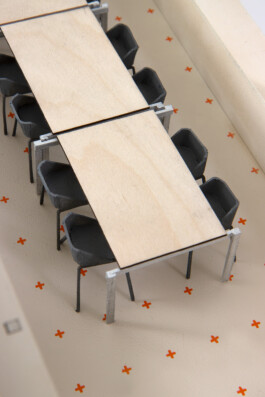
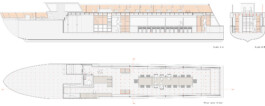
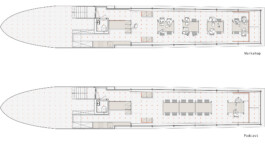
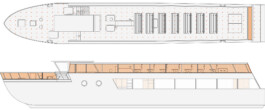
Science comes alive in the “Make Science Halle”. This design allows visitors to immerse themselves in the world of research, where they can actively use scientific tools themselves. Based on a well-structured toolbox, visible markings on the ceiling and floor provide a grid into which shelves and storage space can be integrated. Mobile tables are placed, allowing for a wide range of uses, such as communal dinners, workshops, or podcast recordings.
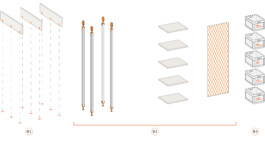
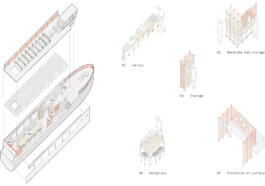
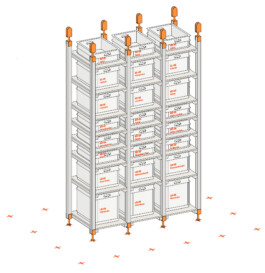
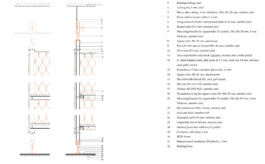
(01) The grid is clearly marked on the floors and ceiling and is partly designed as a mounting system for the new furnishings. (02) Clamped aluminum profiles are supplemented by shelves and steel mesh to create storage and presentation surfaces. (03) Euro container within the shelving structure provide space for numerous research tools. A color-coded guidance system facilitates orientation.
“Science is a way of thinking, a way of approaching life. It is a method of exploration, a toolbox of understanding.”

This project was carried out as part of the funding of the Science Cube – Competence Center for Science Communication by the Federal Ministry for Economic Affairs and Climate Protection (BMWK) on the basis of a resolution by the German Bundestag within the framework of the funding guideline for strengthening the dynamics of transformation and renewal in the mining regions and at coal-fired power plant sites (STARK).
Dieses Projekt wurde im Rahmen der Förderung des Science Cube – Kompetenzzentrum für Wissenschaftskommunikation durch das Bundesministerium für Wirtschaft und Klimaschutz (BMWK) aufgrund eines Beschlusses des Deutschen Bundestags im Rahmen der Förderrichtlinie zur Stärkung der Transformationsdynamik und Aufbruch in den Revieren und an den Kohlekraftwerkstandorten (STARK) durchgeführt.
To the Top
toolbox
A place that makes science tangible
Exhibited at the Bavarian Arts and Crafts Association, Munich (Bayerischer Kunstgewerbeverein e.V.)
PROJECT
ReMake Science · A ship for the encounter between science and people
Collaboration with Elisa Meincken
SUPERVISION
Professor Rita Rentzsch · Research Associate Luise Schuhmann
Period
Summer semester 2025
·
Science comes alive in the “Make Science Halle”. This design allows visitors to immerse themselves in the world of research, where they can actively use scientific tools themselves. Based on a well-structured toolbox, visible markings on the ceiling and floor provide a grid into which shelves and storage space can be integrated. Mobile tables are placed, allowing for a wide range of uses - such as communal dinners, workshops, or podcast recordings.
(01) The grid is clearly marked on the floors and ceiling and is partly designed as a mounting system for the new furnishings. (02) Clamped aluminum profiles are supplemented by shelves and steel mesh to create storage and presentation surfaces. (03) Euro container within the shelving structure provide space for numerous research tools. A color-coded guidance system facilitates orientation.

“Science is a way of thinking, a way of approaching life. It is a method of exploration, a toolbox of understanding.”


This project was carried out as part of the funding of the Science Cube – Competence Center for Science Communication by the Federal Ministry for Economic Affairs and Climate Protection (BMWK) on the basis of a resolution by the German Bundestag within the framework of the funding guideline for strengthening the dynamics of transformation and renewal in the mining regions and at coal-fired power plant sites (STARK).
Dieses Projekt wurde im Rahmen der Förderung des Science Cube – Kompetenzzentrum für Wissenschaftskommunikation durch das Bundesministerium für Wirtschaft und Klimaschutz (BMWK) aufgrund eines Beschlusses des Deutschen Bundestags im Rahmen der Förderrichtlinie zur Stärkung der Transformationsdynamik und Aufbruch in den Revieren und an den Kohlekraftwerkstandorten (STARK) durchgeführt.
To the Top
Website made with LayTheme · Get in touch · Imprint · Privacy Policy

My name is Femi Alexandra Awokoya (born 2003, Germany). I am a student of interior architecture at Burg Giebichenstein University of Art and Design Halle.
This portfolio combines a selection of work from my interior architecture studies and an external project. I am particularly interested in architecture’s responsibility toward society. My focus is on building renovation, sustainable approaches, and the atmospheric and psychological impact of spaces.
My designs are characterized by a calm, minimalist aesthetic, often with a social focus. In addition to designing and visualizing, I am also interested in theoretical discussions about design and society.
Get in touch: f.awokoya03@gmail.com

My name is Femi Alexandra Awokoya (born 2003, Germany). I am a student of interior architecture at Burg Giebichenstein University of Art and Design Halle.
This portfolio combines a selection of work from my interior architecture studies and an external project. I am particularly interested in architecture’s responsibility toward society. My focus is on building renovation, sustainable approaches, and the atmospheric and psychological impact of spaces.
My designs are characterized by a calm, minimalist aesthetic, often with a social focus. In addition to designing and visualizing, I am also interested in theoretical discussions about design and society.
Get in touch: f.awokoya03@gmail.com
PROJEKT
ReMake Science · Ein Schiff für die Begegnung von Wissenschaft und Mensch
Zusammenarbeit mit Elisa Meincken
BETREUUNG
Prof. Rita Rentzsch · KM Luise Schuhmann
Zeitraum
Sommersemester 2026
·
In der Make Science Halle wird Wissenschaft erfahrbar. Dieser Entwurf erlaubt es Besucher:innen in die Forschungswelt einzutauchen, in der sie die Werkzeuge der Wissenschaft selbst aktiv nutzen können. Orientiert an einer gut strukturierten Werkzeugkiste geben sichtbare Markierungen an Decke und Boden ein Raster vor, in welches Regale eingespannt, Stauraum einsortiert und mobile Tische platziert werden und somit vielfältige Nutzungsmöglichkeiten erlaubt - etwa gemeinschaftliches Dinner, Workshops oder Podcastaufnahmen.
·
Das Raster ist an Böden und Decke gut sichtbar markiert und teilweise als Befestigungen für die neue Einrichtung ausgeführt.Eingespannte Aluminiumprofile werden durch Regalböden und Stahlnetze zu Stauraum- und Präsentationsflächen ergänzt. Innerhalb der Regalstruktur bieten Eurokisten Platz für zahlreiche Forschungstools. Ein farbig akzentuiertes Leitsystem erleichtert die Orientierung.
Planzeichnungen, Details, Deckenspiegel