House Luisa
A place of healing and new beginnings
PROJECT
Kiezhotel · Staying overnight in vacant urban properties
Collaboration with Julia Gensch
SUPERVISION
Professor Rita Rentzsch · Research Associate Janna Radlow
PERIOD
Winter semester 2024/2025
·
A collaboration between Hanover University of Applied Sciences and Arts and Burg Giebichenstein University of Art and Design Halle.
·
House Luisa makes an important contribution to the fight against domestic violence. To this end, vacant properties in the city are used and the rooms are converted into safe havens.
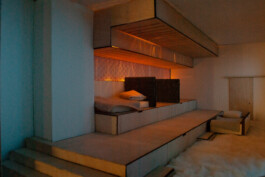

The phrase “Is Luisa there?” is a coded question or code that discreetly asks for help without attracting the attention of potential perpetrators. The idea is to make women aware of our safe haven with the term “House Luisa.”
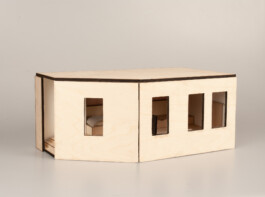
Existing building in Hanover
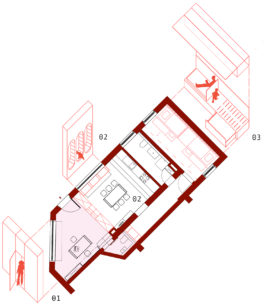
Existing building in Halle
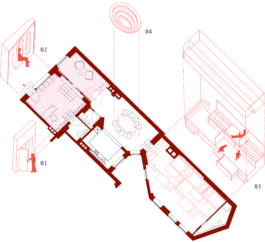
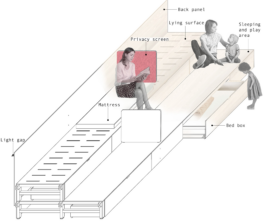
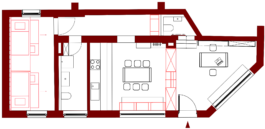
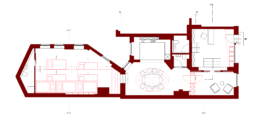
To create a protected and private space, the following elements are essential:
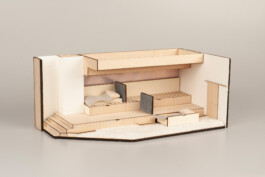
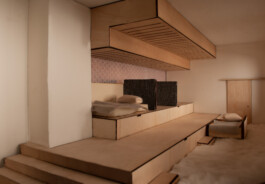
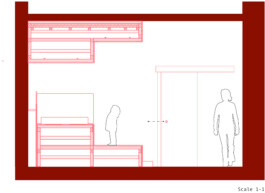
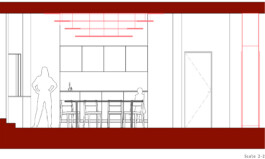
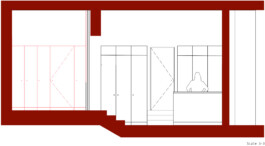
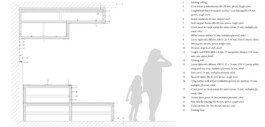
Concealed cabinet doors (01) establish a clear separation between public areas (entrance and counseling space) and private zones, while seating niches (02) offer a discreet place of retreat upon arrival. The two platforms with ceiling-mounted acoustic elements (03), including pull-out beds in the dormitory, provide additional sleeping spaces as well as a generous play area for children. The ceiling elements (04) contribute to a more comfortable spatial atmosphere by visually lowering the ceiling height through an attractive installation.

Thanks to pull-out bed boxes, the platform can be quickly and easily adapted to suit individual needs. Mattresses without slatted frames can be placed on the top level thanks to milled recesses. To ensure greater privacy, privacy screens and acoustic elements are incorporated into the platform. The felt material used not only absorbs noise, but can also be customized or used as a pinboard.
To the Top
House Luisa
A place of healing and new beginnings
PROJECT
Kiezhotel · Staying overnight in vacant urban properties
Collaboration with Julia Gensch
SUPERVISION
Professor Rita Rentzsch · Research Associate Janna Radlow
PERIOD
Winter semester 2024/2025
·
A collaboration between Hanover University of Applied Sciences and Arts and Burg Giebichenstein University of Art and Design Halle.
·
House Luisa makes an important contribution to the fight against domestic violence. To this end, vacant properties in the city are used and the rooms are converted into safe havens.


The phrase “Is Luisa there?” is a coded question or code that discreetly asks for help without attracting the attention of potential perpetrators. The idea is to make women aware of our safe haven with the term “House Luisa.”
Existing building in Halle

Existing building in Hanover

To create a protected and private space, the following elements are essential:
Concealed cabinet doors (01) establish a clear separation between public areas (entrance and counseling space) and private zones, while seating niches (02) offer a discreet place of retreat upon arrival. The two platforms with ceiling-mounted acoustic elements (03), including pull-out beds in the dormitory, provide additional sleeping spaces as well as a generous play area for children. The ceiling elements (04) contribute to a more comfortable spatial atmosphere by visually lowering the ceiling height through an attractive installation.

Thanks to pull-out bed boxes, the platform can be quickly and easily adapted to suit individual needs. Mattresses without slatted frames can be placed on the top level thanks to milled recesses. To ensure greater privacy, privacy screens and acoustic elements are incorporated into the platform. The felt material used not only absorbs noise, but can also be customized or used as a pinboard.


To the Top
Website made with LayTheme · Get in touch · Imprint · Privacy Policy

My name is Femi Alexandra Awokoya (born 2003, Germany). I am a student of interior architecture at Burg Giebichenstein University of Art and Design Halle.
This portfolio combines a selection of work from my interior architecture studies and an external project. I am particularly interested in architecture’s responsibility toward society. My focus is on building renovation, sustainable approaches, and the atmospheric and psychological impact of spaces.
My designs are characterized by a calm, minimalist aesthetic, often with a social focus. In addition to designing and visualizing, I am also interested in theoretical discussions about design and society.
Get in touch: f.awokoya03@gmail.com

My name is Femi Alexandra Awokoya (born 2003, Germany). I am a student of interior architecture at Burg Giebichenstein University of Art and Design Halle.
This portfolio combines a selection of work from my interior architecture studies and an external project. I am particularly interested in architecture’s responsibility toward society. My focus is on building renovation, sustainable approaches, and the atmospheric and psychological impact of spaces.
My designs are characterized by a calm, minimalist aesthetic, often with a social focus. In addition to designing and visualizing, I am also interested in theoretical discussions about design and society.
Get in touch: f.awokoya03@gmail.com
PROJEKT
ReMake Science · Ein Schiff für die Begegnung von Wissenschaft und Mensch
Zusammenarbeit mit Elisa Meincken
BETREUUNG
Prof. Rita Rentzsch · KM Luise Schuhmann
Zeitraum
Sommersemester 2026
·
In der Make Science Halle wird Wissenschaft erfahrbar. Dieser Entwurf erlaubt es Besucher:innen in die Forschungswelt einzutauchen, in der sie die Werkzeuge der Wissenschaft selbst aktiv nutzen können. Orientiert an einer gut strukturierten Werkzeugkiste geben sichtbare Markierungen an Decke und Boden ein Raster vor, in welches Regale eingespannt, Stauraum einsortiert und mobile Tische platziert werden und somit vielfältige Nutzungsmöglichkeiten erlaubt - etwa gemeinschaftliches Dinner, Workshops oder Podcastaufnahmen.
·
Das Raster ist an Böden und Decke gut sichtbar markiert und teilweise als Befestigungen für die neue Einrichtung ausgeführt.Eingespannte Aluminiumprofile werden durch Regalböden und Stahlnetze zu Stauraum- und Präsentationsflächen ergänzt. Innerhalb der Regalstruktur bieten Eurokisten Platz für zahlreiche Forschungstools. Ein farbig akzentuiertes Leitsystem erleichtert die Orientierung.
Planzeichnungen, Details, Deckenspiegel